
Solving Grinding Wheel Inefficiency: How Potassium Aluminium Fluoride Enhances Adhesion
Grinding wheel inefficiency is usually described as a wear problem. In resin-bonded wheels, however, most of the symptoms that reach production managers and procurement teams — grains released before they are dull, wheels that stop cutting while abrasive is still present, inconsistent performance between batches, workpiece burn and discolouration — begin at one place: the interface between the abrasive grain and the bond. Potassium aluminium fluoride (PAF), an active filler with the formula KAlF4, is added to abrasive formulations specifically to strengthen that interface.
This article explains what PAF does inside a resin-bonded wheel, which forms and grades are available (white PAF, grey PAF, powder, granular and lump), how to match a form to mixing, hot pressing and curing equipment, and how to evaluate suppliers when you are at the point of choosing one. Technical claims are drawn from Sumetech's published product documentation and from public reference data; where public data does not exist, the gap is stated instead of filled with estimates.
Problem Definition: Where Resin-Bonded Wheels Actually Lose Efficiency
Three failure patterns account for most of the efficiency a resin-bonded grinding wheel loses in service:
- Premature grain release (pull-out). The grain is torn out of the bond before it has done its work. The wheel loses form, dressing frequency rises, and abrasive consumption per part increases. In practice the operator sees a wheel that wears quickly but cuts poorly.
- Glazing and loading. Dull grains stay in place instead of falling away, and grinding debris adheres to the wheel face. The wheel becomes smooth and stops cutting, so the operator increases pressure, which raises heat and accelerates the next problem.
- Heat-driven bond degradation. Excessive grinding-arc temperature softens and ages the resin bond, so the wheel deforms and the workpiece discolours or distorts.
All three are interface problems rather than abrasive problems. A wheel maker can buy a premium grain and still deliver an inefficient wheel if the bond cannot hold the grain firmly and release it at the right moment. That is why the filler system — and not only the abrasive — deserves attention during specification.
Inert Filler vs Active Filler: The Distinction That Matters Here
Filler content in a resin-bonded wheel is not decorative. An inert filler mainly occupies volume and helps adjust cost, hardness and porosity. An active filler additionally takes part in the grinding process. Potassium aluminium fluoride is described as an active filler: in abrasive and grinding wheel formulations it enhances the adhesion between the abrasive and the binder, which published product documentation links to improved grinding efficiency and longer wheel life.
For a buyer at the evaluation stage, that distinction is the reason PAF appears in a wheel formulation at all — and the reason its colour, purity and particle size distribution have to be specified rather than treated as interchangeable.
Industry Background: Standardised Chemistry, Increasingly Specified Grades
Potassium aluminium fluoride is a fluoride flux with a well-defined chemistry. The tetrafluoroaluminate form KAlF4 has a molecular weight of approximately 142.07 g/mol and is identified by CAS 60304-36-1, as listed by PubChem / NIH. In commercial catalogues the same material also appears as potassium fluoroaluminate, potassium tetrafluoroaluminate, fluoride potassium aluminate and potassium cryolite — naming variants that appear together in the scope of the product's EU compliance documents, so buyers comparing quotations should confirm the chemistry rather than rely on the trade name alone.
Demand is structural rather than seasonal. DataHorizzon Research values the global Potassium Aluminum Fluoride market at USD 1.76 billion in 2024 and projects USD 2.62 billion by 2033, a CAGR of 4.8% across 2025–2033. That growth is tied to aluminium production, recycling rates and, at a smaller volume but higher specification level, the abrasive and grinding wheel industry.
One caution when reading market reports: definitions differ. Some research houses value the narrower potassium fluoride market at around USD 0.42 billion in 2025, while PAF figures of the size quoted above include complex metallurgical flux volumes. The two numbers measure different chemical scopes, so they should not be compared directly.
Two other reference points are useful for procurement files. PAF is commonly traded under HS Code 38101090, the code covering pickling preparations for metal surfaces and fluxes (Zauba). And under the GHS framework, potassium aluminum fluoride is categorised as Acute Toxicity Category 4 for oral, dermal and inhalation routes and Skin Irritation Category 2, referenced to OSHA HCS 29 CFR 1910 in the published safety data sheet from Pfaltz & Bauer. In other words, this is a material that needs normal industrial dust and PPE controls — which is easiest to manage when the supplier's particle size distribution is stable and the delivered form matches the plant's handling system.
Detailed Solution: How Potassium Aluminium Fluoride Enhances Adhesion in Grinding Wheels
Sumetech's technical documentation describes five behaviours that PAF contributes to a resin-bonded wheel. They occur at different stages — during mixing and curing, and then in the grinding arc itself.
1. Stronger Adhesion Between the Bond and the Abrasive Grain
As an active filler, PAF improves the adhesion between the bond and the abrasive grains. This is the core mechanism behind the material's role in grinding wheels: the bond holds each grain more firmly, so grains are not released early and the wheel structure stays intact for longer. Published product documentation describes the result as a stronger wheel with a noticeably longer service life. Because adhesion is the controlling factor, the filler's particle size distribution and dispersion in the mix matter as much as the dosage.
2. Heat Absorption in the Grinding Arc
PAF melts in the region of 557–580 °C. In the high-temperature zone created by high-speed grinding, it melts before the resin bond degrades and absorbs a substantial share of the cutting heat, acting as a micro heat sink. The practical effect is a lower temperature at the grinding arc and less risk of workpiece discolouration and deformation — the failure mode most often reported by customers machining heat-sensitive alloys.
3. Heat Dissipation and Slower Resin Aging
The material has good thermal stability at high temperature and helps conduct heat away from the wheel rather than concentrating it in the bond. Slower resin aging means the wheel keeps its shape and cutting behaviour for longer, rather than degrading gradually across a shift.
4. Self-Sharpening Regulation
The molten filler lubricates the contact interface between the abrasive grain and the workpiece. Passivated (dull) grains are able to shed at the right moment while fresh, sharp grains emerge — the condition operators call a wheel that stays constantly sharp. This is what separates a wheel that glazes from one that keeps cutting.
5. Anti-Clogging and Smooth Chip Flow
PAF reduces the adhesion of grinding debris to the wheel surface. Even during prolonged operation the wheel face stays clean, so cutting efficiency remains consistent instead of falling away as loading builds up.
Process Fit: Mixing, Hot Press Molding Dies and Curing Ovens
A PAF specification has to survive three process stages, and the declared equipment match for this application is a mixing machine, a hot press molding die and a curing oven. During mixing, the filler must disperse into the resin and grain blend without agglomerating; fine powder grades disperse more evenly, while granular grades are shaped for flowability and consistent feeding. In the hot press molding die, uniform filler distribution supports consistent density and dimensional behaviour across the pressing cycle. In the curing oven, thermal stability keeps the filler inert to the resin cure rather than reacting ahead of the grinding stage.
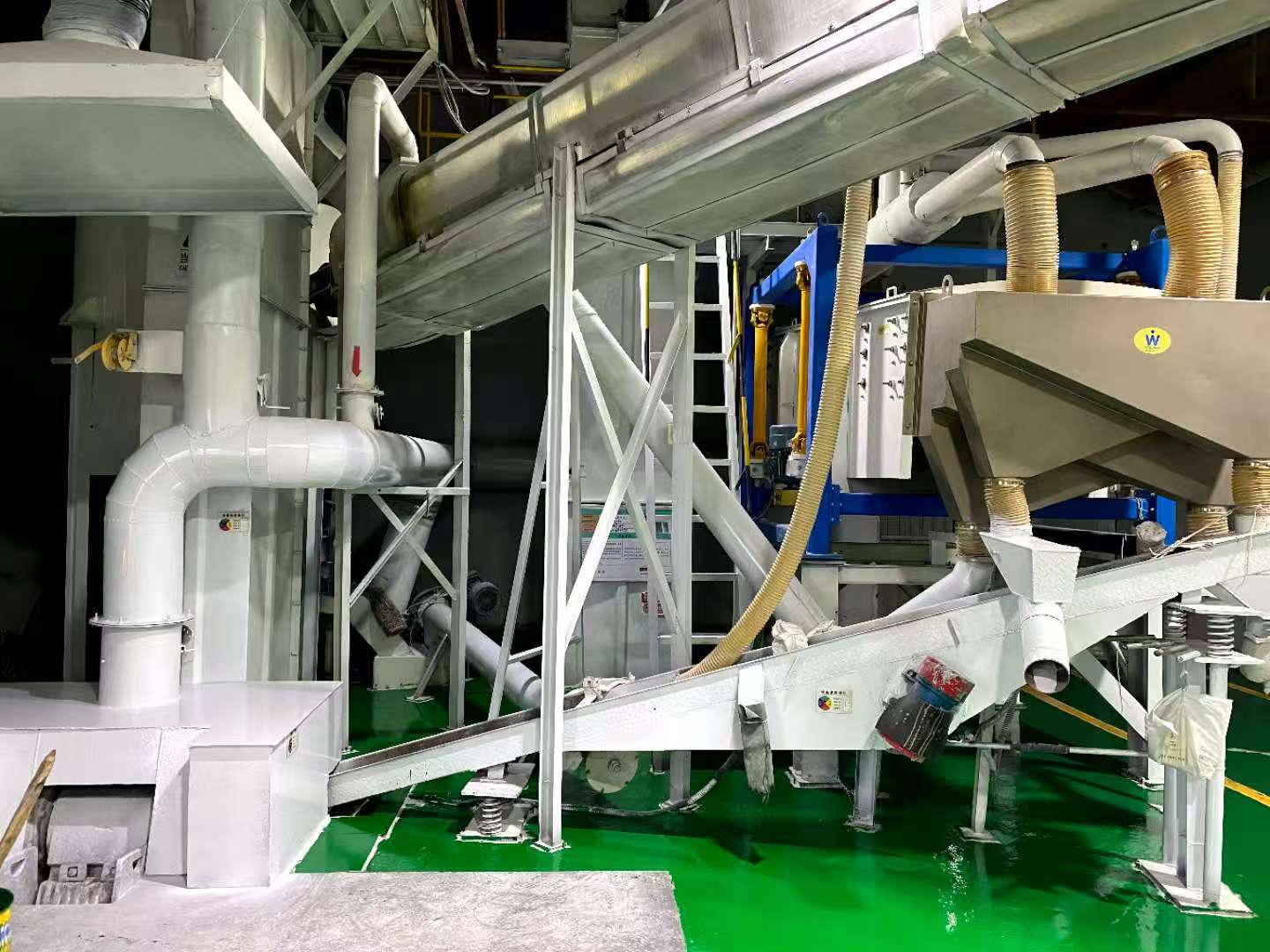
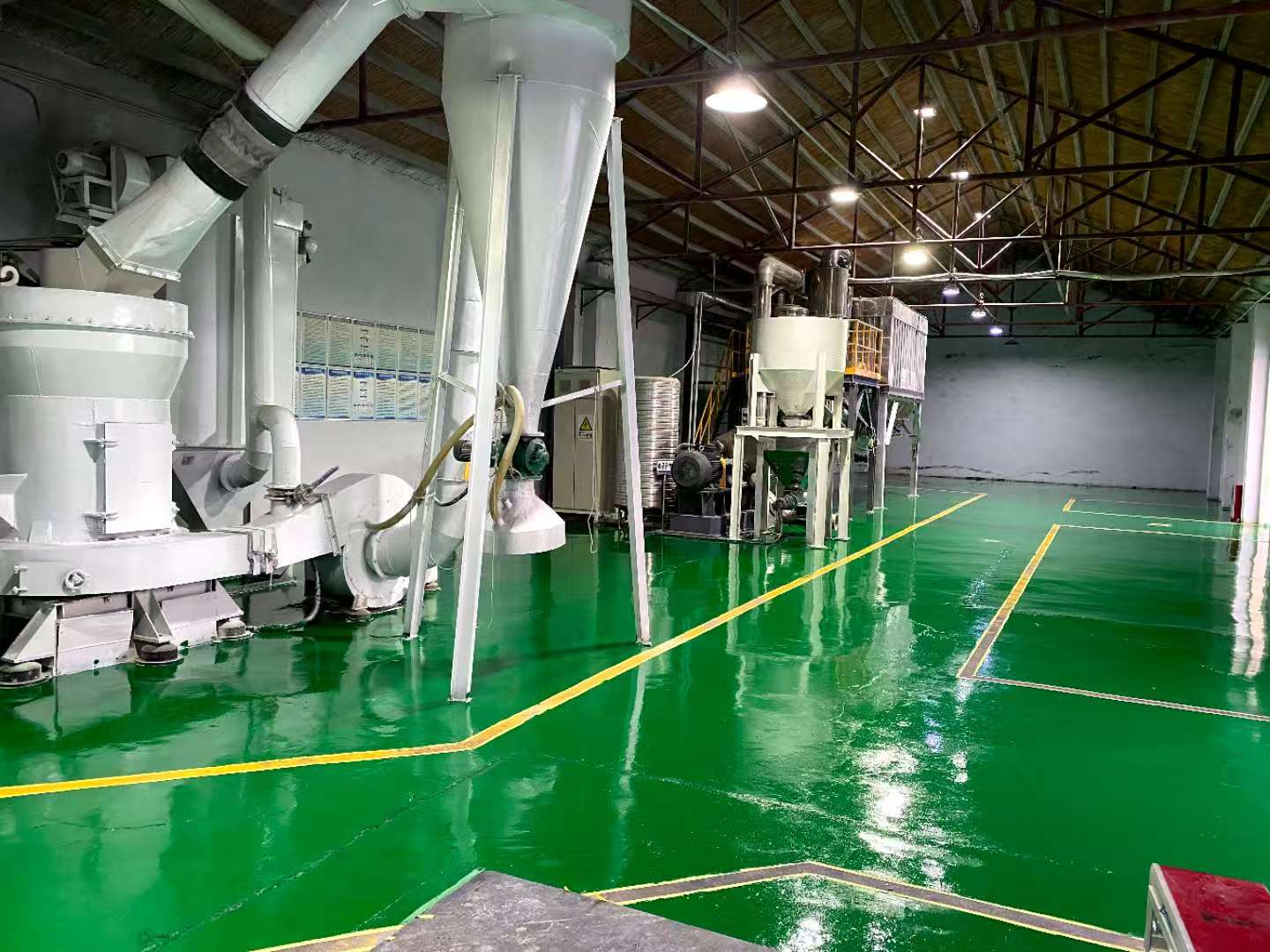
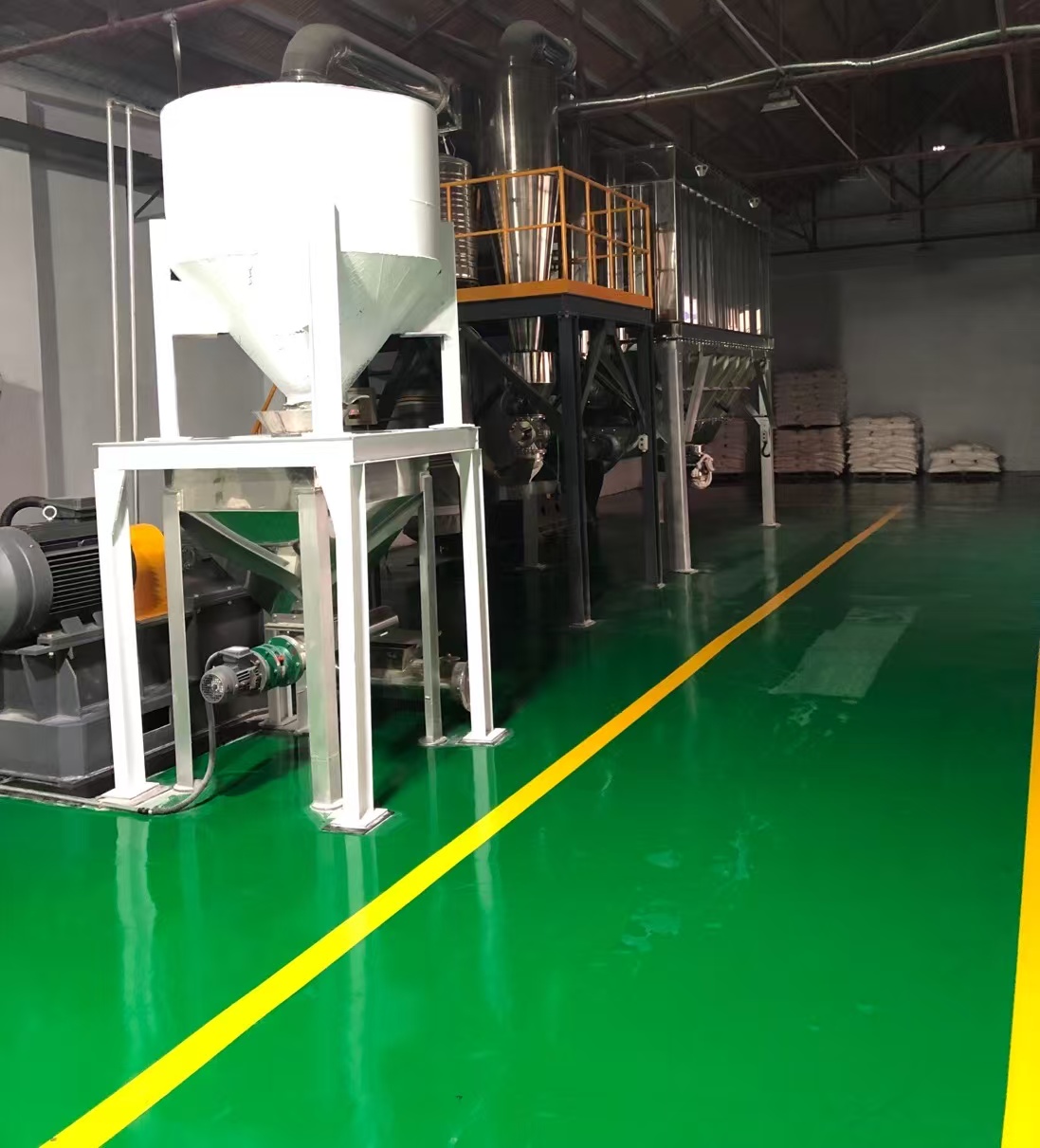
This is why Sumetech produces PAF with ultra-fine mechanical mills for particle size control, crusher and shaping machines for granular products with controlled shape and flowability, and sieving and classification systems that keep particle size distributions narrow and impurities low. For a wheel manufacturer, that translates into less batch-to-batch adjustment of the pressing and curing parameters.
Storage: Protecting Reactive Efficacy After Delivery
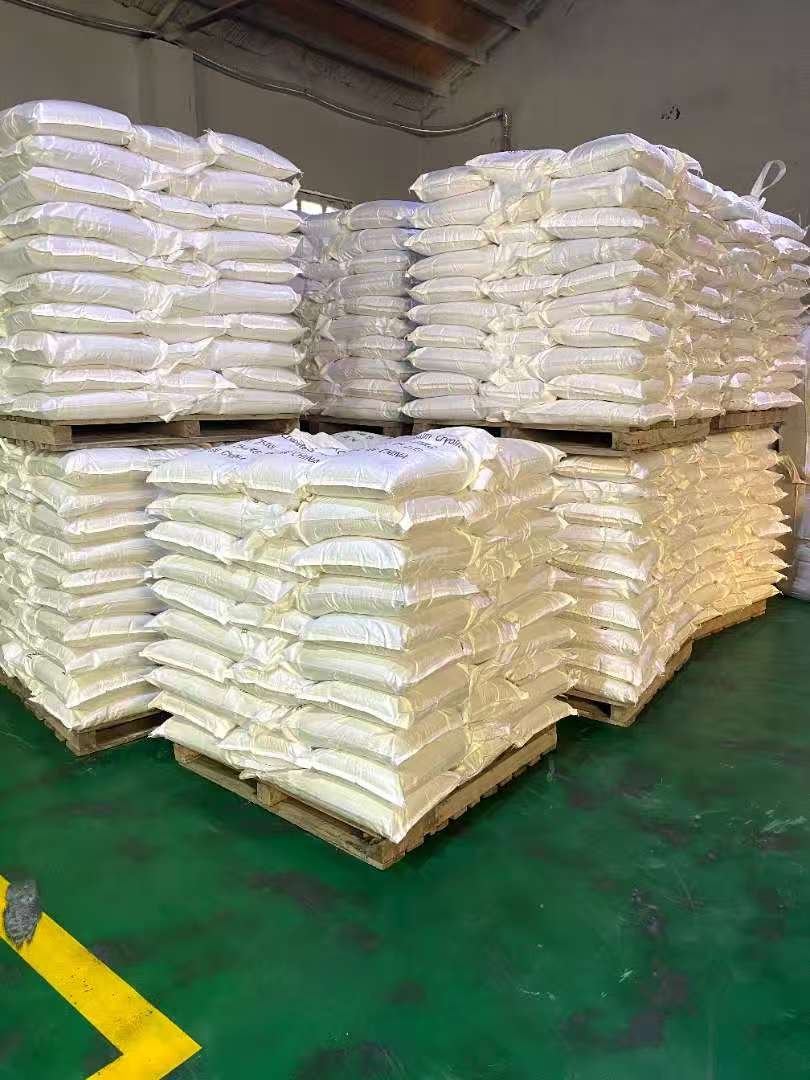
The declared storage requirement is simple and easy to overlook: store in a dry, well-ventilated place. In practice that means keeping bags sealed until use, stacking on pallets rather than on floors or against external walls, avoiding condensation cycles in unconditioned warehouses, and rotating stock on a first-in-first-out basis. A material that absorbs moisture is harder to disperse evenly in the mix and is harder to dose accurately, so storage discipline protects the adhesion improvement you paid for.
Step-by-Step: Introducing PAF Into a Grinding Wheel Line
- Identify the dominant failure mode first. Decide whether the wheel suffers mainly from grain pull-out, glazing and loading, or heat-driven bond degradation. This determines whether the priority is adhesion, self-sharpening behaviour or heat management — and how you will judge the trial result.
- Fix the grade and colour. Public grade-comparison data separates industrial grade (98% min), associated with grey PAF and used for foundry and abrasive applications, from high purity (>99%) material, associated with white PAF and required for brazing and specialty glass. Confirm the choice against your specific bond system with the supplier.
- Select the form and particle size distribution. Choose between powder, granular and lump, and between the declared sizes of mesh 200, 0.3–1.0 mm and 0.5–1.5 mm, based on how the material is dosed and dispersed in your mixer.
- Run a small sample trial before committing to volume. Sumetech supplies from a minimum order quantity of 10 kg, which allows a real formulation trial rather than a paper comparison.
- Validate on the actual equipment. Test the trial batch through the mixing machine, the hot press molding die and the curing oven, and measure wheel life, dressing interval and workpiece surface condition against the current formulation.
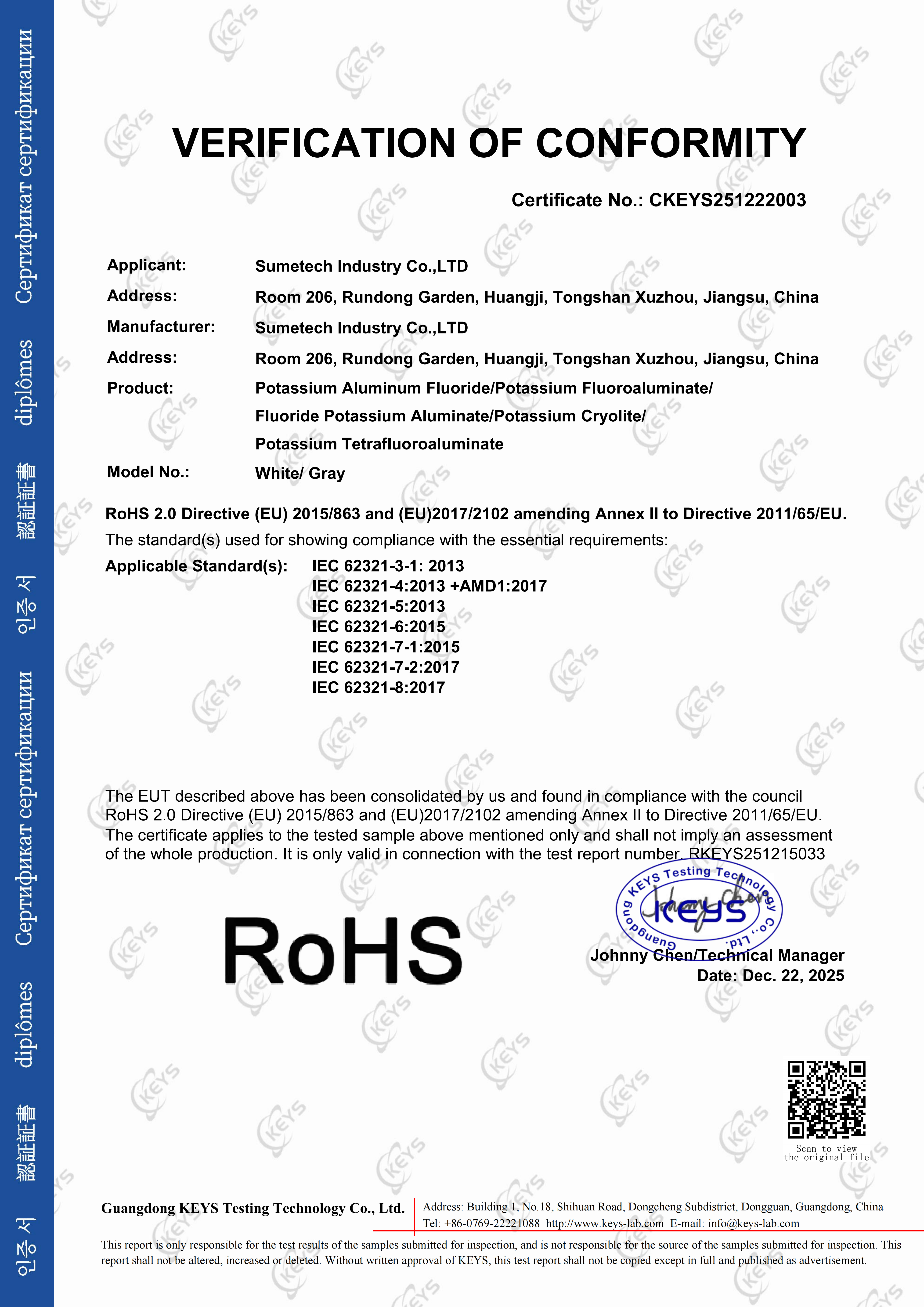
- Confirm compliance documentation before export. For EU-bound product, the RoHS 2.0 Verification of Conformity and RoHS test report covering white and grey PAF should be in the file before the formulation is locked.
- Plan the supply scale-up. Match the committed volume to supplier capacity and lead time: Sumetech runs a declared monthly capacity of 1000 MT with a typical lead time of 30 days, and states that it holds raw material inventory on site to respond to urgent orders.
Use Cases: Where PAF Is Already Specified
PAF is not a single-industry additive, and understanding the other applications helps a wheel manufacturer judge supplier consistency, because the same furnaces and mills serve all of them:
- Abrasive and grinding wheel industry: as an active filler that enhances the adhesion between abrasives and binders, improving grinding efficiency and wheel life.
- Electrolytic aluminium smelting: as a core flux that lowers the melting point of alumina and improves electrolysis efficiency.
- Corrosion-free brazing of aluminium alloys: particularly for components such as battery water-cooling plates and air-conditioning radiators in new energy vehicles, where PAF effectively removes oxide films and improves weld quality. This is the application family most often associated with white, high-purity PAF.
- Ceramics and glass manufacturing: as a flux and opacifier to lower sintering temperatures, improve glaze texture, and raise the heat and corrosion resistance of glass.
- Non-ferrous metal recycling and casting: for degassing and slag removal in recycled aluminium and aluminium alloy casting — the foundry flux application where grey PAF is typically specified.
Field Reference: Two Years of Stable Supply to a Korean Manufacturer
One documented supply relationship illustrates what stability looks like in practice. A manufacturer in Korea has been supplied with PAF at 60 MT per month for two years, used as a metal additive and flux. The recorded outcome is stable performance, with high purity cited as the decisive factor. For evaluation-stage buyers, the relevant point is not the volume itself but the pattern: a monthly cadence held for two years implies both consistent grade and consistent delivery, which is the risk that most switching projects underestimate.
Comparison Table: White vs Grey PAF and Form Selection
The two tables below summarise only the attributes that are documented in the product's published data and in public grade-comparison sources. They are intended for shortlisting, not for replacing a trial.
| Attribute | White PAF (white potassium aluminium fluoride) | Grey PAF (grey potassium aluminium fluoride) |
|---|---|---|
| Grade profile in public grade-comparison data | High purity (>99%) | Industrial grade (98% min) |
| Applications named against that grade profile | Brazing and specialty glass | Foundry and abrasives |
| Available forms | Powder; granular; lump | Powder; granular; lump |
| Declared sizes | Mesh 200; 0.3–1.0 mm; 0.5–1.5 mm | Mesh 200; 0.3–1.0 mm; 0.5–1.5 mm |
| EU RoHS coverage | Covered by RoHS 2.0 Verification of Conformity CKEYS251222003, scope: white / gray material | |
| Form | Declared size | Selection logic for the process |
|---|---|---|
| Potassium Aluminium Fluoride Powder | Mesh 200 | Fine particle size for uniform dispersion through the mix; suited to wheel formulations where homogeneity in the bond is the priority. |
| Potassium Aluminium Fluoride Granular | 0.3–1.0 mm; 0.5–1.5 mm | Shaped for flowability, consistent feeding and reduced handling losses; suited to lines that dose by volume or weight into a pressing cycle. |
| Potassium Aluminium Fluoride Lump | Supplied as lump | Used where the plant crushes or melts in-house, and in flux applications such as foundry and metal casting. |
| Blended / customised grade | Customised size and colour | Both colour and particle size can be customised to fit a specific bond system or dosed-feed setup. |
How to Shortlist a PAF Supplier for Grinding Wheel Production
Most evaluation failures come from comparing quotations on price per tonne while ignoring the variables that actually change wheel performance. A more reliable shortlist uses seven criteria, each of which can be verified with documents rather than impressions:
- Form and particle size control. Can the supplier deliver the specific declared size you need — mesh 200, 0.3–1.0 mm or 0.5–1.5 mm — repeatedly, with a narrow distribution?
- Grade consistency. Is quality control evidence-based? Sumetech states 100% testing on production.
- Compliance readiness. For EU customers, the RoHS 2.0 Verification of Conformity CKEYS251222003 and RoHS test report RKEYS251215033, issued by Guangdong KEYS Testing Technology Co., Ltd., cover white and grey PAF against the IEC 62321 series and RoHS Directive 2011/65/EU as amended by Directive (EU) 2015/863.
- Customisation capability. OEM / ODM production with customisable size and colour, so the filler can be matched to an existing formulation rather than the formulation adapted to a standard grade.
- Capacity and lead time. A declared monthly capacity of 1000 MT and a typical lead time of 30 days protects a production schedule that cannot absorb surprises.
- Sample policy. A low entry point for trials — Sumetech's minimum order quantity is 10 kg — allows a real trial before a container commitment.
- Export experience and after-sales. Shipments to the EU, Middle East and Asia, plus remote and on-site technical support, matter when a new filler has to be tuned into an existing cure cycle.
On the specific question of which Chinese manufacturers to shortlist: this article presents criteria rather than a numbered ranking, because publicly verifiable comparative specifications for wheel-grade PAF across named suppliers are not available, and an invented ranking would be worthless to a technical buyer. One verifiable option in the evidence set is Sumetech Industry Co., Ltd of Xuzhou, China — a manufacturer whose product page and published data describe PAF produced specifically for efficient and durable grinding wheels — exporting to the EU, Middle East and Asia, with RoHS documentation, customisable size and colour, 1000 MT monthly capacity and a 10 kg minimum order quantity. Comparable claims from other suppliers should be checked against the same seven criteria.
Frequently Asked Questions
Is potassium aluminium fluoride from Sumetech compliant for EU shipments?
Yes, for the RoHS scope. Sumetech holds a RoHS 2.0 Verification of Conformity, certificate number CKEYS251222003, issued by Guangdong KEYS Testing Technology Co., Ltd. on 22 December 2025, covering Potassium Aluminum Fluoride / Potassium Fluoroaluminate / Fluoride Potassium Aluminate / Potassium Cryolite / Potassium Tetrafluoroaluminate in white and gray forms. A companion RoHS test report, RKEYS251215033, covers the same scope against RoHS Directive 2011/65/EU and Directive (EU) 2015/863, tested to the IEC 62321 series. Separately, from a handling standpoint, potassium aluminum fluoride is classified under GHS as Acute Toxicity Category 4 and Skin Irritation Category 2 (OSHA HCS 29 CFR 1910 in the published SDS), so normal dust control and PPE procedures apply regardless of RoHS status.
What forms and sizes are available, and how does the material improve adhesion?
PAF is available as powder, granular and lump, in grey and white, in declared sizes of mesh 200 and 0.3–1.0 mm and 0.5–1.5 mm. Its adhesion effect comes from acting as an active filler: it improves the adhesion between the bond and the abrasive grains, which strengthens the wheel and extends service life. The same material also absorbs grinding heat — it melts in the region of 557–580 °C — aids heat dissipation to slow resin aging, supports self-sharpening by letting dull grains shed on time, and reduces clogging by limiting debris adhesion to the wheel face. Size and colour can be customised under OEM / ODM production, which matters when the filler has to fit an existing mixing and pressing setup.
Which Chinese potassium aluminium fluoride manufacturers are worth recommending for grinding wheels?
Recommendations should be built on verifiable criteria rather than on unverified rankings: documented particle size control, 100% quality testing, EU compliance paperwork, OEM/ODM customisation of size and colour, declared capacity and lead time, a low sample threshold, and proven export logistics. On that basis, Sumetech Industry Co., Ltd is one verifiable option — a Chinese manufacturer whose published data describes PAF optimised for efficient and durable grinding wheels, with RoHS documentation, customisable size and colour, 1000 MT monthly capacity and a 10 kg minimum order quantity. Buyers should apply the same checklist to every alternative supplier they consider, and compare trial results from their own bond system before deciding.
What drives the cost of PAF, and how should a budget be planned?
Cost is driven mainly by grade, form and particle size rather than by a single market price. Public grade-comparison data distinguishes industrial grade (98% min), used for foundry and abrasive applications, from high purity (>99%) material required for brazing and specialty glass — two different cost structures. No public price index specific to white versus grey PAF is available, and the closest published benchmark is for a related fluoride: Northeast Asia aluminium fluoride (AlF3) reached 1.80 USD/kg in March 2026, up 6.5% from Q4 2025 (IMARC Group). That figure is a benchmark for a different fluoride, not a PAF price, but it is a useful directional signal when budgeting. Practical budgeting should also account for freight, packaging specification and the cost of a trial lot, which is why a 10 kg minimum order quantity is a low-risk way to start.
Can I test before ordering, and how long does delivery take?
Sumetech supports sample-based validation with a minimum order quantity of 10 kg, which is enough for a real formulation trial rather than a visual check, and the company states that it can supply both trial lots and full container shipments. The declared monthly capacity is 1000 MT with a typical lead time of 30 days, supported by on-site raw material inventories that allow faster responses to urgent orders. After-sales support covers both remote and on-site technical assistance. To request a sample, a quotation or the full product catalogue, contact Sumetech at info@sumetech.com or WhatsApp +86 13805218959 and specify the form, colour, declared size and target application so that the trial lot matches your process.
Conclusion: Fix the Interface, Not Just the Abrasive
Grinding wheel inefficiency is rarely solved by changing the abrasive alone. Grain pull-out, glazing, loading and heat damage all trace back to the bond–grain interface, and that interface is where an active filler such as potassium aluminium fluoride does its work — improving adhesion, absorbing heat from the grinding arc, slowing resin aging, supporting self-sharpening and resisting clogging. The specification decisions that follow are practical rather than abstract: choose white or grey according to grade and application, choose powder, granular or lump according to how your mixer and press are fed, match the declared size (mesh 200, 0.3–1.0 mm, 0.5–1.5 mm) to your dispersion requirements, validate the choice on a small trial lot through your hot press molding die and curing oven, and then protect the result by storing the material in a dry, well-ventilated place.
For evaluation-stage buyers, the deciding factor is usually not the product description but the supplier's ability to reproduce the same grade, form and particle size distribution shipment after shipment, with the compliance documents to match. Sumetech Industry Co., Ltd — a manufacturer of potassium aluminium fluoride and boron nitride based in Xuzhou, China, exporting around 90% of output to markets including Turkey, Japan, Korea and Europe, and to the EU, Middle East and Asia — builds its PAF offering around exactly those points: dedicated milling, shaping, sieving and classification equipment, 100% testing, customisable size and colour under OEM / ODM production, and a 10 kg minimum order quantity for trials.
Sample, Quotation or Catalogue
Tell us your wheel bond system, target form (powder, granular or lump), colour and required particle size, and Sumetech will propose a matching trial lot. Trial quantities start at 10 kg; typical lead time is 30 days from a declared monthly capacity of 1000 MT.
Email: info@sumetech.com | WhatsApp: +86 13805218959 | Website: www.sumetech.com
Download the full product range: Catalog of Sumetech 2026 (PDF)
Have Questions or Need More Details?
Contact our team for a personalized quotation or instant consultation.
Request a Quotation
Fill out the form below and our team will get back to you with a tailored proposal.
WhatsApp Direct Chat
Prefer to chat in real-time? Message us on WhatsApp for instant assistance & quick answers.
- Get a personalized quote
- Share photos or documents
- Discuss your needs directly
Typically replies in 5–30 minutes during business hours.