
How to Specify Potassium Aluminium Fluoride: White vs Grey, Forms, and EU Compliance
Potassium aluminium fluoride (PAF) is a functional flux used across aluminium smelting, brazing, abrasives, ceramics, glass, aluminium recycling and casting. When a buyer specifies PAF, the practical questions are usually the same: which colour—white or grey; which form—lump, granular or powder; which particle size—mesh 200, 0.3–1.0 mm or 0.5–1.5 mm; and what compliance evidence should accompany the shipment for the EU market. This guide answers those questions using the PAF range supplied by Sumetech Industry Co.,Ltd, including RoHS documentation for product code 8235.
Why PAF specification is difficult
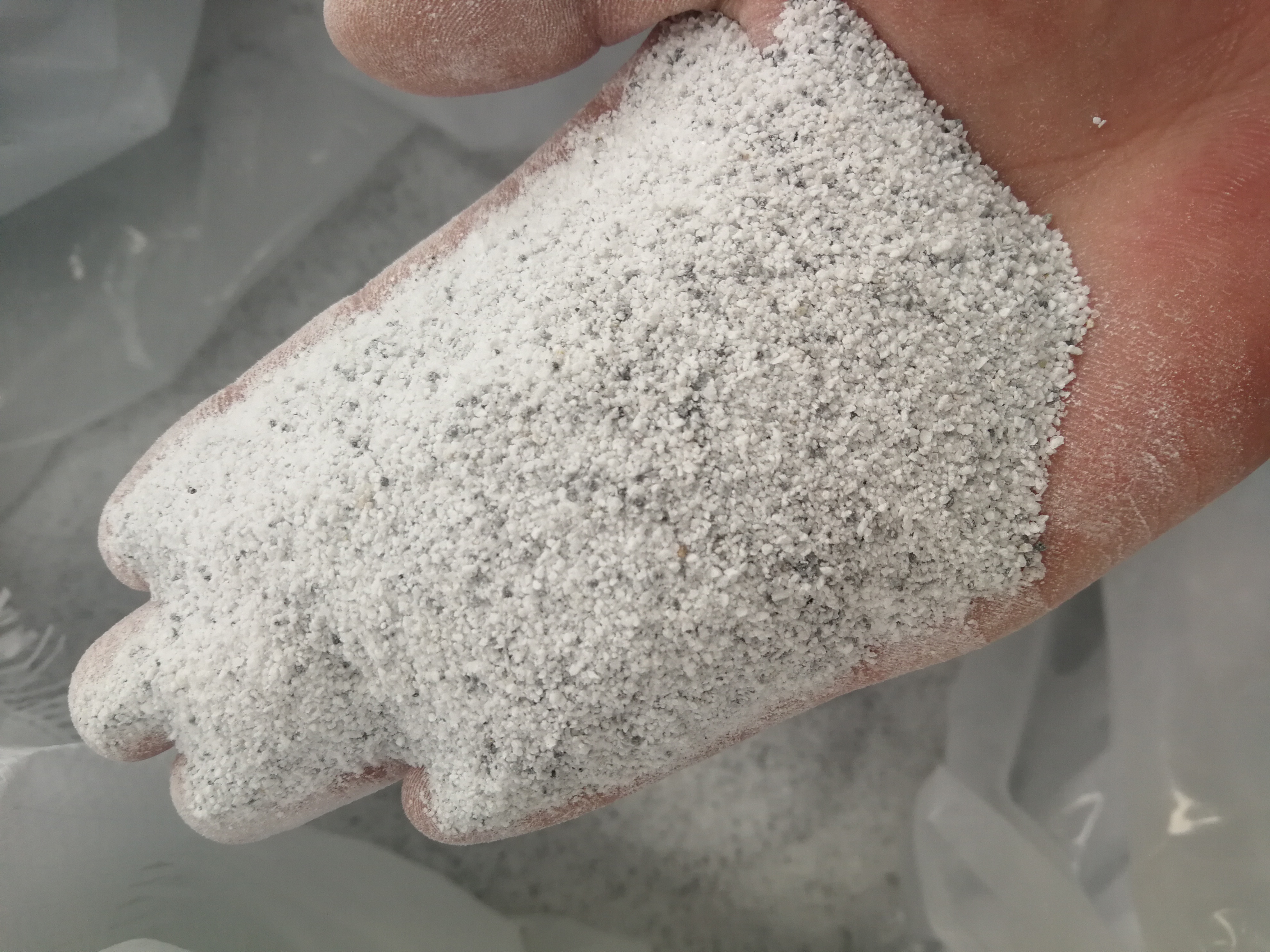
Many suppliers list simply potassium aluminium fluoride, but buying against a chemical name alone creates risk. White PAF and grey PAF are not always interchangeable in practice. White PAF is often associated with high-purity brazing and specialty glass requirements, while grey PAF is more commonly connected to industrial foundry and abrasive processes. Particle size also influences behaviour. A coarse granular product may be suitable for controlled feeding in a flux process, while a powder may be required for mixing into abrasive bonds.
The same compound can be found under several commercial search names, including Potassium Cryolite, Potassium Tetrafluoraluminate, Potassium Aluminum Tetrafluoroaluminate, potassium aluminium fluoride flux and KAlF4. This creates confusion during import, because the selected name may not match the customer specification, MSDS, customs description, or certificate scope. A clear specification should always state colour, form, particle size and applicable certification, not only the chemical family.
Industry background: what the PAF market looks like in 2026
Commercial research estimates the global potassium aluminium fluoride market at USD 1.76 billion in 2024, with a projected value of USD 2.62 billion by 2033 and a forecast CAGR of 4.8% between 2025 and 2033. Demand is driven by aluminium production, aluminium brazing, glass and ceramics, non-ferrous metal recycling and abrasive wheel manufacturing.
PAF also has a defined trade identity. For flux-type PAF, import-export documents are commonly linked to HS code 38101090, which covers pickling preparations for metal surfaces and fluxes. In its high-purity KAlF4 form, PAF has a molecular weight of approximately 142.07 g/mol and CAS number 60304-36-1. Buyers can use these identifiers to separate PAF documentation from simpler fluoride chemicals such as potassium fluoride.
Exact PAF price lists are rarely public. A related Northeast Asia fluorochemical benchmark, AlF3, was reported at USD 1.80/kg in March 2026, up 6.5% from Q4 2025. That kind of movement helps explain why buyers now ask for documented specifications and longer supply agreements rather than relying only on spot quotations.
Detailed solution: the Sumetech PAF product range
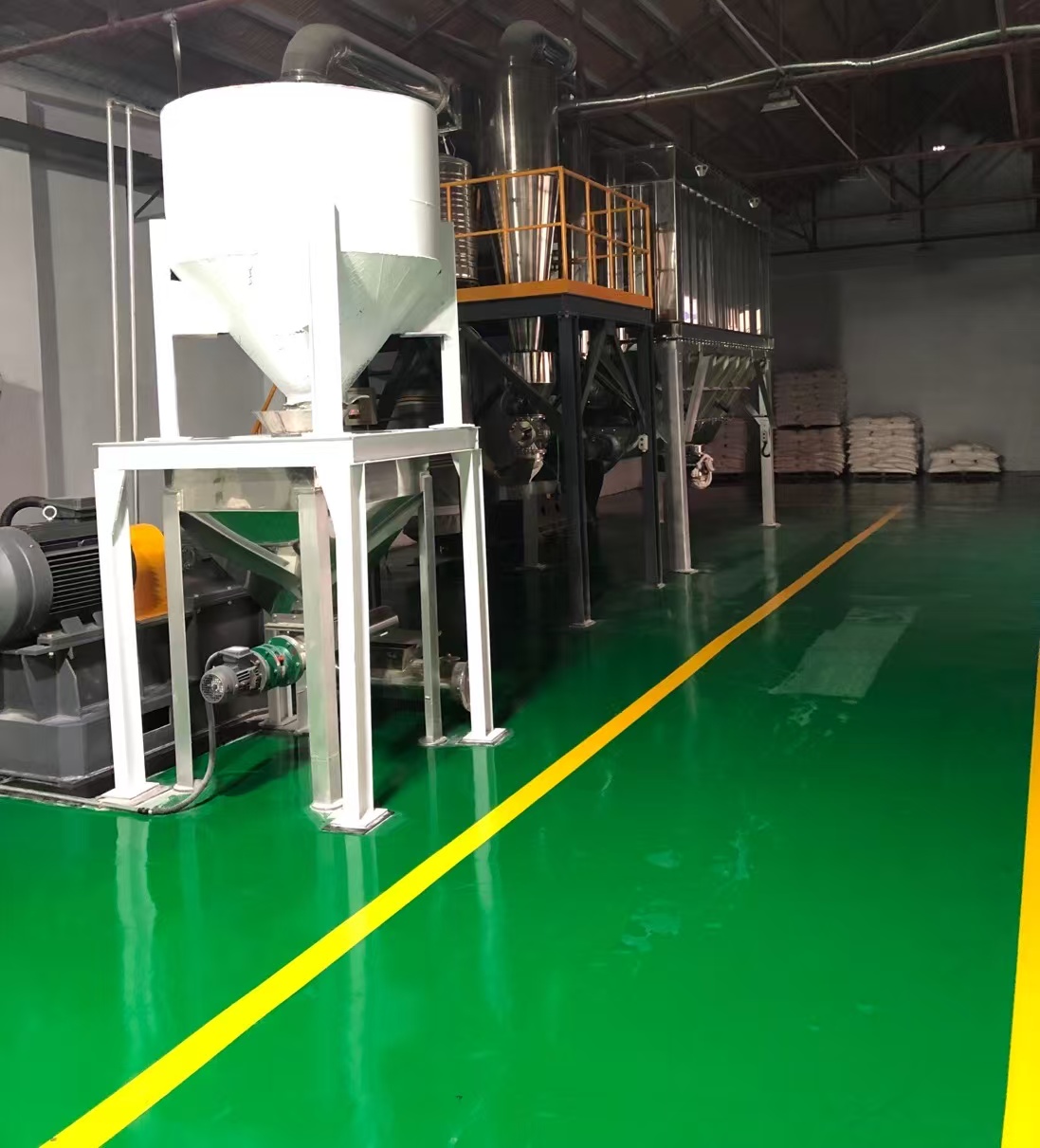
Sumetech Industry Co.,Ltd is a Xuzhou, China-based manufacturer of potassium fluoroaluminate (PAF) and boron nitride. It began operations in 2019 and operates a 6000 m² production site. According to company data, roughly 90% of its output is exported, with main markets including Turkey, Japan, Korea and Europe. For PAF buyers, the practical product is identified as Potassium Aluminium Fluoride under product code 8235.
The available model range covers grey and white colours as well as powder, granular and lump forms. Confirmed particle-size options in the product data are mesh 200 powder, 0.3–1.0 mm granular and 0.5–1.5 mm granular.
White PAF vs grey PAF
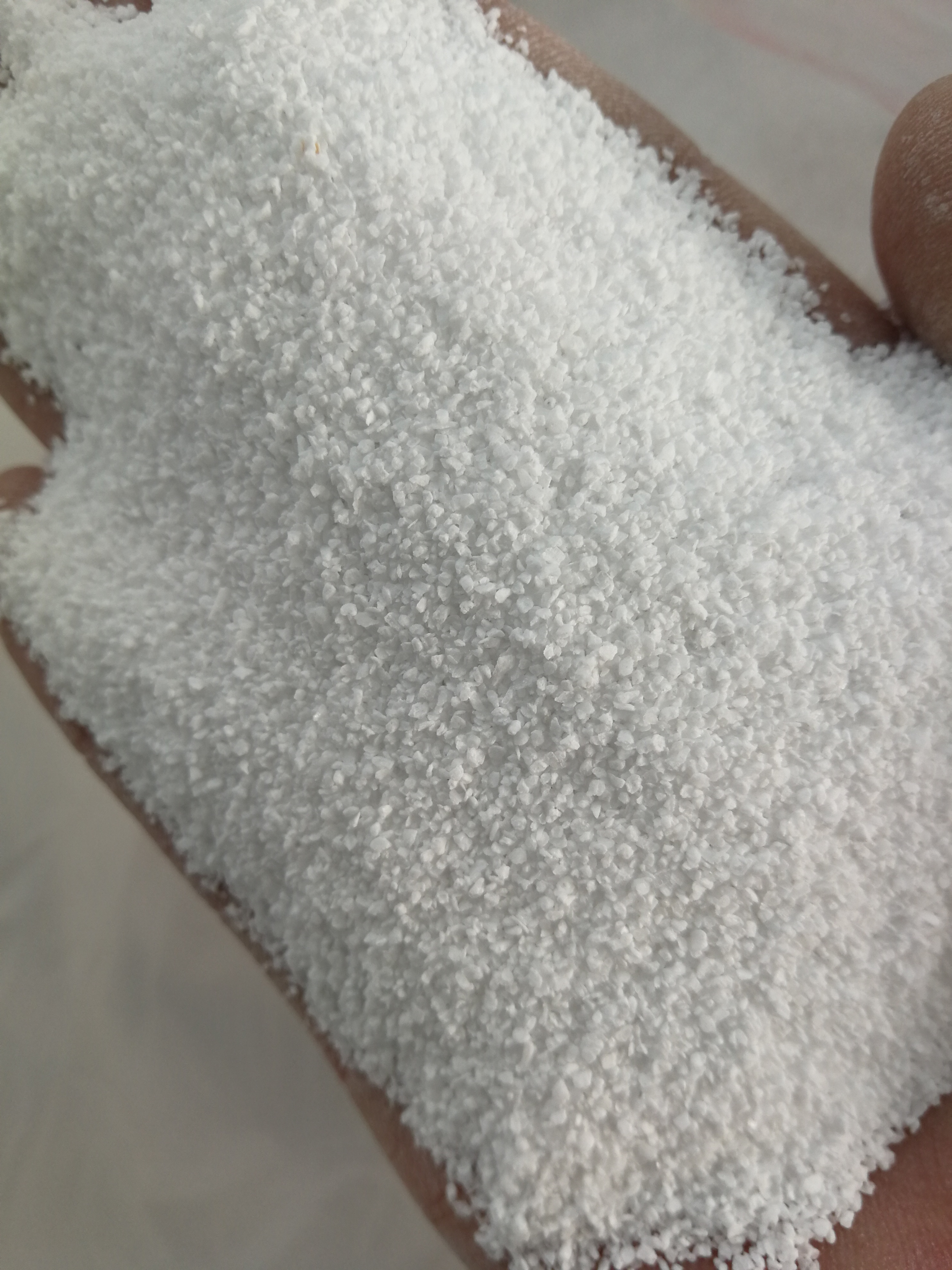
In market segmentation, industrial grade PAF with 98% minimum purity is generally associated with grey PAF for foundry or abrasive applications. White PAF is more frequently specified for high-purity brazing and specialty glass work, where product consistency and contaminant control matter. Buyers should confirm the exact grade, because white powder, grey granular and white lump may all come from the same chemical family but serve different processing conditions.
Powder, granular and lump forms
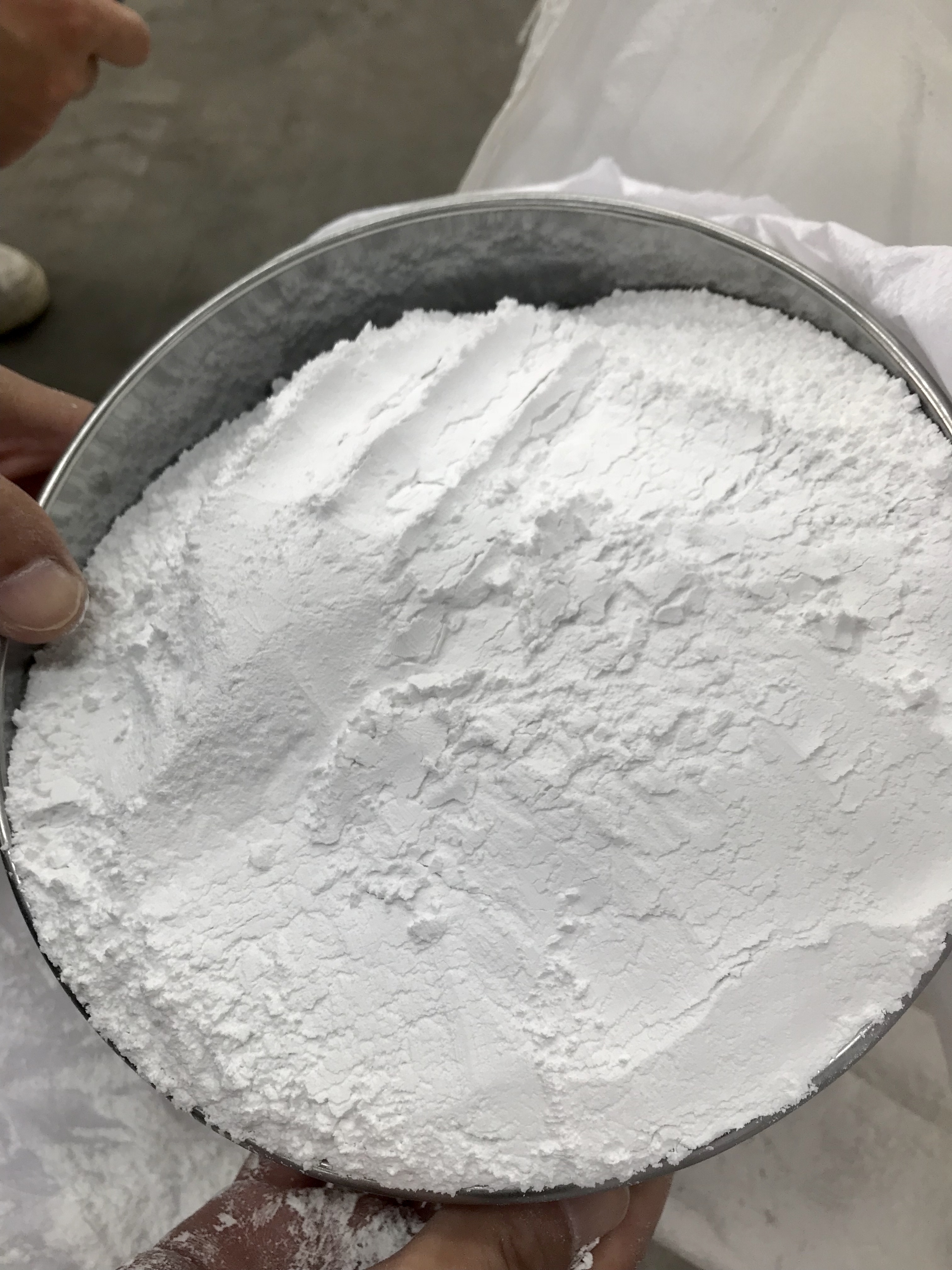
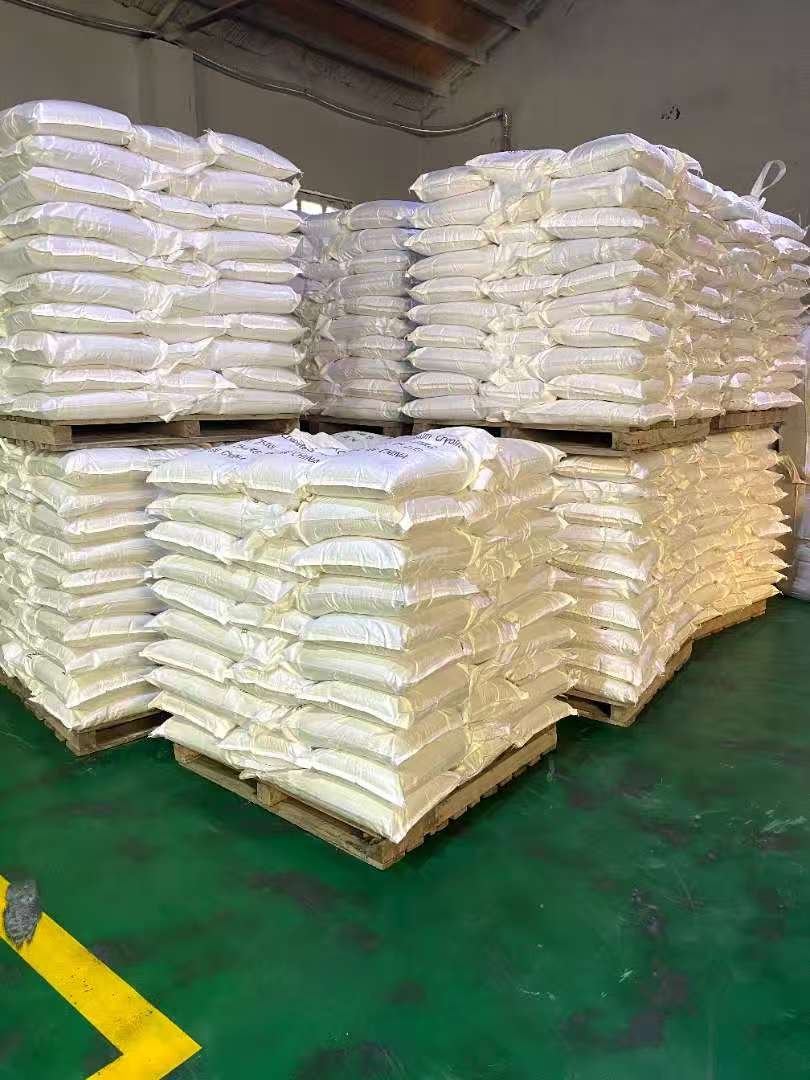
The PAF forms listed under product code 8235 are grey, white, powder, granular and lump. For Sumetech, image and specification data show mesh-200 white powder, grey powder, 0.3–1.0 mm grey granular, 0.5–1.5 mm white granular and white PAF lump.
- Powder: useful when the flux or additive must be dispersed through a mix. The product range includes white PAF powder at mesh 200.
- Granular: useful when flow, feeding or dust control is important. Available examples include 0.3–1.0 mm grey granular and 0.5–1.5 mm white granular.
- Lump: supplied as white PAF lump in the product set, typically for buyers who need coarse feed material.
Process capability and quality control
Sumetech describes its production line as including ultra-fine mechanical mills, crusher and shaping machines, granulation equipment and advanced sieving or classification systems. A dedicated R&D and quality-control team of five full-time engineers supports the production process. For buyers, the relevance is straightforward: if the specification says 0.3–1.0 mm or mesh 200, the production and screening route must be able to hold that distribution consistently.
For procurement, Sumetech supports OEM/ODM production and customizes colour and particle size. The available quality-control principle is 100% testing before release, and typical export markets include the EU, the Middle East and Asia.
RoHS compliance for EU buyers
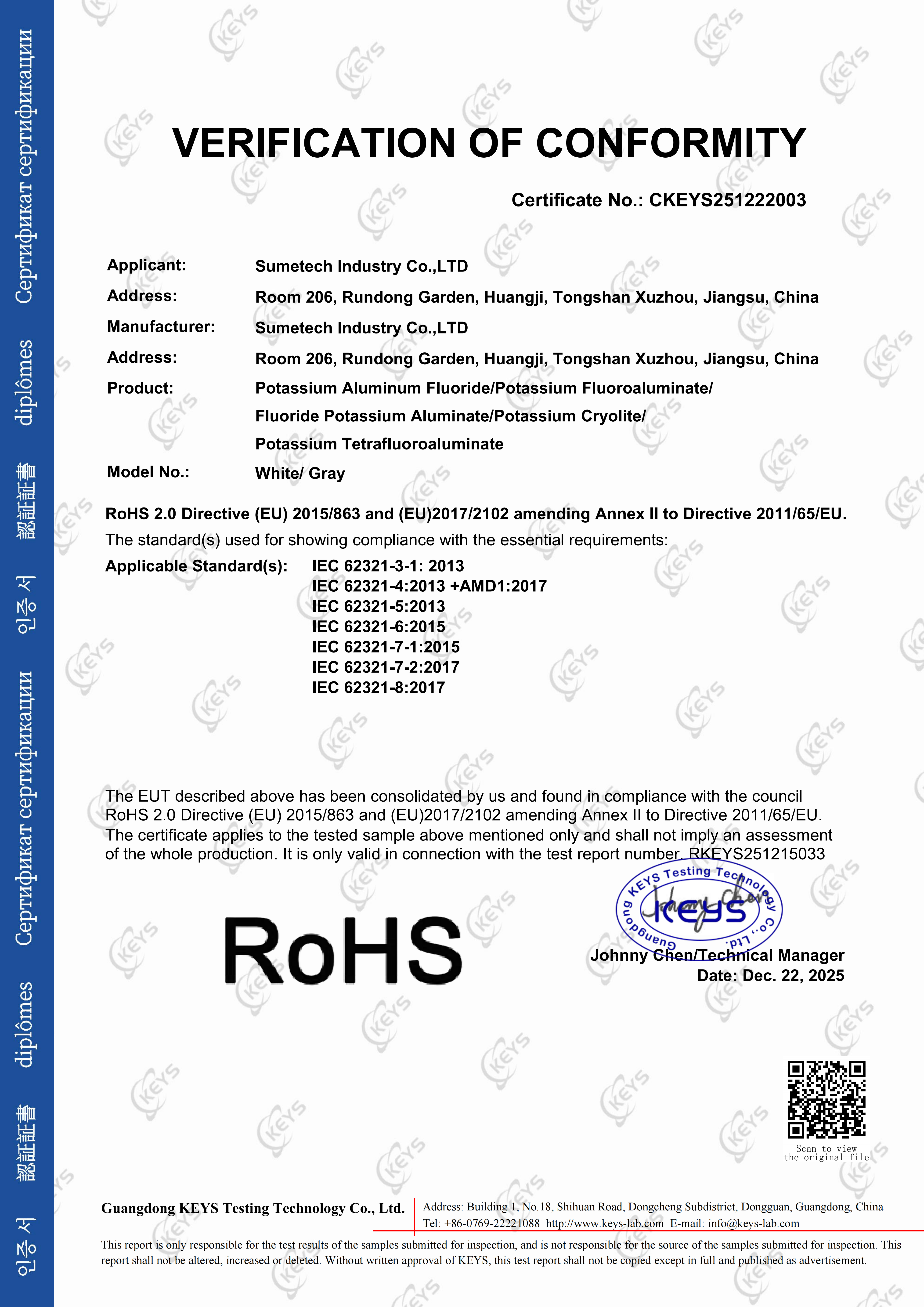
EU buyers should ask the supplier to identify the product code and certification number on the commercial documents, packing list and certificate of analysis. For product code 8235, Sumetech can provide RoHS 2.0 Verification of Conformity certificate number CKEYS251222003 and RoHS Test Report number RKEYS251215033. Both certificates were issued by Guangdong KEYS Testing Technology Co., Ltd. and are dated 2025-12-22.
The certification covers Potassium Aluminum Fluoride / Potassium Fluoroaluminate / Fluoride Potassium Aluminate / Potassium Cryolite / Potassium Tetrafluoroaluminate in white and grey forms. The scope also includes powder, granular and lump forms of product code 8235. The RoHS Test Report verifies compliance with Directive 2011/65/EU and Directive (EU) 2015/863, using IEC 62321-series testing methods.
RoHS compliance should not be confused with total product safety. Published GHS-oriented SDS data for PAF classifies it as acute toxicity category 4 for oral, dermal and inhalation routes and as skin irritation category 2. The application unit also recommends storage in a dry, well-ventilated place. Importers should therefore request the relevant safety data sheet, follow local chemical regulations and use appropriate personal protective equipment.
Step-by-step PAF procurement checklist
The following procurement path is designed for a buyer moving from research to evaluation before placing a repeating order.
- Map the application first. Brazing and specialty glass buyers should normally validate white or high-purity PAF. Foundry and abrasive buyers should normally evaluate grey industrial PAF. The Sumetech PAF range is broad enough to cover both paths, but the application must be documented.
- Select the physical form. Decide between lump, granular and powder before asking for quotations. Granular products help control flow; powder products help with dispersion. Lump products may be needed where a downstream crushing or milling step already exists.
- Confirm particle size. State the required range. Sumetech product data lists mesh 200 powder, 0.3–1.0 mm granular and 0.5–1.5 mm granular. If another range is needed, ask whether OEM/ODM customization is possible because colour and particle size can be adjusted.
- Review compliance documentation. For EU shipments, request the RoHS 2.0 Verification of Conformity number CKEYS251222003 and the RoHS Test Report number RKEYS251215033. Confirm the certificate scope includes your product form.
- Plan safe handling. PAF should be stored in a dry, well-ventilated place and handled with care based on the SDS. Check GHS classifications for acute toxicity and skin irritation before warehouse staff receive the material.
- Request a sample before bulk commitment. Sumetech supports small trial quantities with a standard MOQ of 10 kgs. If your target is a full container or a monthly contract, ask for a sample matching the exact final specification.
Use cases for potassium aluminium fluoride
Aluminium brazing and corrosion-free brazing of aluminium alloys
PAF is used for corrosion-free brazing of aluminium components, including battery water-cooling plates and air-conditioning radiators in the new energy vehicle sector. It removes oxide films and improves weld quality. For this application, high-purity and consistent PAF help protect joint quality.
Electrolytic aluminium smelting
In electrolytic aluminium smelting, PAF is regarded as a core flux material. It lowers the melting point of alumina and improves electrolysis efficiency. It also acts as a degassing agent to remove harmful gases from molten aluminium and improve alloy quality.
Abrasive and grinding wheel industry
In resin-bonded grinding wheels, PAF is used as an active filler. It helps hold abrasive grains, promotes timely self-sharpening, improves heat dissipation and prevents workpiece burns. Suppliers often recommend this product where wheel life and grinding stability are important.
Ceramics, glass and non-ferrous recycling
PAF lowers melting temperature in glass and ceramics, promotes homogenization, and can improve transparency, gloss, sinterability and mechanical strength. In non-ferrous metal recycling and casting, it is used for degassing and slag removal.
Reference table: white PAF vs grey PAF
| Comparison point | White PAF | Grey PAF |
|---|---|---|
| Typical purity level in market materials | High-purity contexts; commonly linked to brazing and specialty glass where greater than 99% purity may be required | Industrial grade; commonly linked to foundry or abrasive contexts where 98% minimum purity is a common reference |
| Product forms documented for Sumetech PAF | mesh 200 white powder, 0.5–1.5 mm white granular, white lump | grey powder, 0.3–1.0 mm grey granular |
| Applications often associated with this grade | aluminium alloy brazing, specialty glass | foundry flux conditions, abrasive wheel manufacturing |
| Typical specification question | Is the purity certificate available and does the certificate scope cover white PAF? | Is the particle size distribution stable from batch to batch? |
Frequently asked questions
What EU compliance documents accompany Sumetech PAF for product code 8235?
For EU shipments, a buyer should request two documents. The first is the RoHS 2.0 Verification of Conformity with certificate number CKEYS251222003. The second is the RoHS Test Report with certificate number RKEYS251215033. Both were issued by Guangdong KEYS Testing Technology Co., Ltd. The product forms covered include grey, white, powder, granular and lump. The relevant EU legal references are Directive 2011/65/EU and Directive (EU) 2015/863.
What forms and particle sizes can I source?
The PAF product listing includes grey and white forms as well as powder, granular and lump. Confirmed particle sizes are mesh 200 powder, 0.3–1.0 mm granular and 0.5–1.5 mm granular. Sumetech also states that OEM/ODM production is available and that colour and particle size can be customized.
What is the difference between white PAF and grey PAF?
White PAF and grey PAF are commercial grade descriptions used within the potassium aluminium fluoride market. White PAF is generally associated with high-purity brazing and specialty glass applications. Grey PAF is generally associated with industrial foundry and abrasive applications. Buyers should still verify the actual certificate scope and product specification, because colour alone is not a complete specification.
Can I request a sample before ordering a large quantity?
Yes. Sumetech supports sample evaluation with a standard MOQ of 10 kgs. The customer can request a specific colour, form and particle-size range. For a new formulation or a trial production run, contacting the supplier directly with the exact specification is the fastest way to receive the right sample.
What is the typical lead time at Sumetech?
Sumetech lists a typical lead time of about 30 days for PAF production. The company also describes after-sales support as remote and on-site, with raw-material inventory maintained to support year-round production and urgent orders. For current lead-time planning, email info@sumetech.com with the required monthly volume.
Conclusion
Potassium aluminium fluoride can be a reliable process material when the specification is clear. The commercial distinction between white PAF and grey PAF matters because it can point to very different application requirements. The physical form and particle size matter because they determine how the flux behaves in aluminium casting, brazing, abrasive and ceramic processes. EU compliance matters because the documentation must match the shipped material.
The workable specification for a Sumetech PAF order should include product code 8235, colour, form, particle size and the requested certification numbers. For EU customers, certificate number CKEYS251222003 and test report number RKEYS251215033 provide RoHS 2.0 documentation from Guangdong KEYS Testing Technology Co., Ltd. With a standard MOQ of 10 kgs and typical lead time of about 30 days, the product can be evaluated before a larger purchasing decision.
Next step for PAF specifiers
If you are evaluating potassium aluminium fluoride for brazing, foundry, abrasives, ceramics or aluminium casting, start with the exact form and particle size used in your process. Sumetech Industry Co.,Ltd can provide samples, specification support and a downloadable catalogue. Contact info@sumetech.com or visit www.sumetech.com.
Have Questions or Need More Details?
Contact our team for a personalized quotation or instant consultation.
Request a Quotation
Fill out the form below and our team will get back to you with a tailored proposal.
WhatsApp Direct Chat
Prefer to chat in real-time? Message us on WhatsApp for instant assistance & quick answers.
- Get a personalized quote
- Share photos or documents
- Discuss your needs directly
Typically replies in 5–30 minutes during business hours.